 Atify
Back in 2022, much of our work involved creating conversational automation solutions powered by natural language understanding and processing (NLU/NLP). These systems helped companies respond to their customers automatically. You taught the system to recognise what someone wanted, then designed the paths the conversation could take. Tedious, detailed work - and we got good at it!
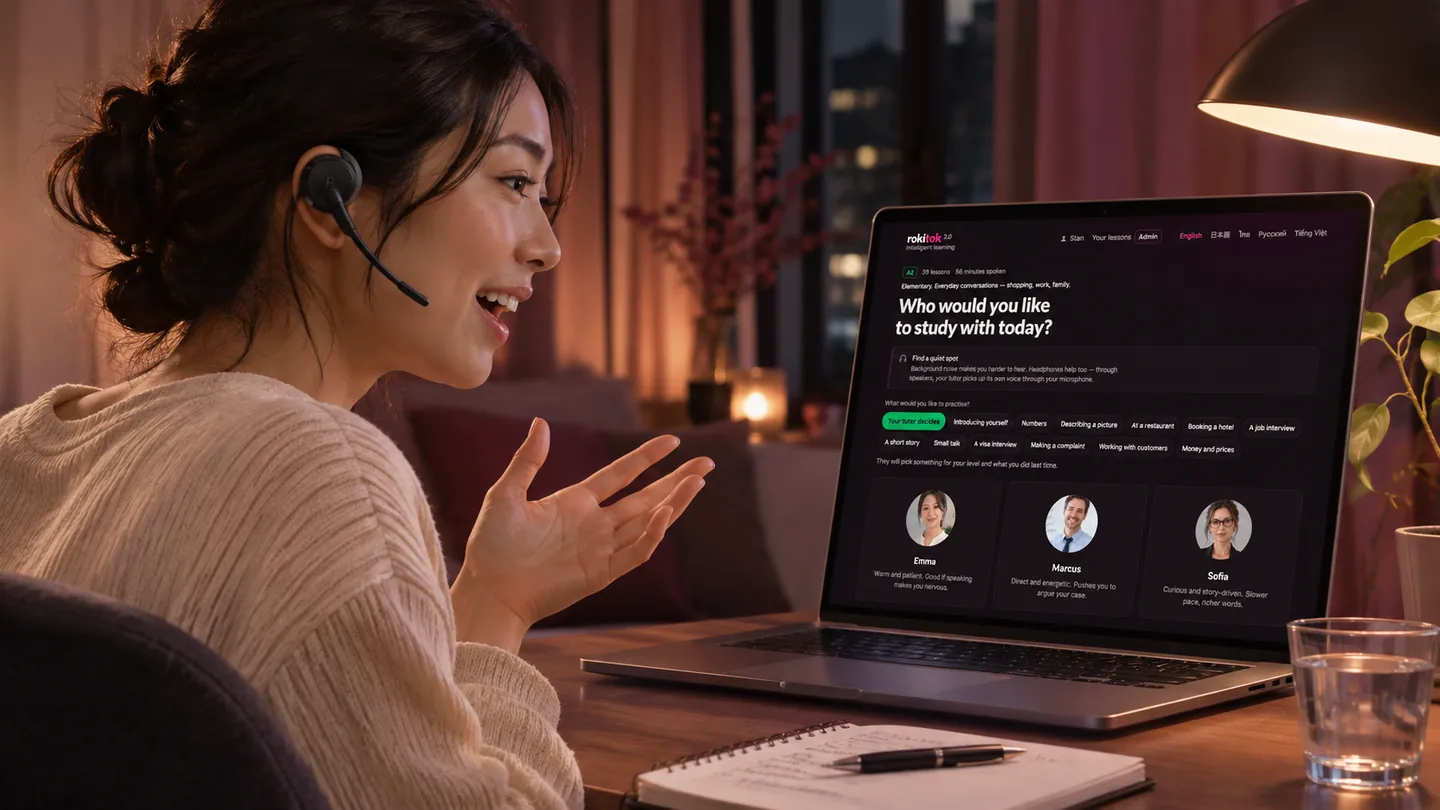
At some point, we wondered whether the same technology could help people practice a language. Could a system designed to understand customer questions become a conversation partner for someone learning English?
That became RokiTok. We built the first version in 2022 as an experiment to see what would happen.
It worked. But there was a problem.
People liked it. Learners liked it, teachers liked it. For many, having a conversation with an AI tutor was a “wow” moment. The value was there.
What we had underestimated was how much work each lesson would take to create.
Every lesson had to be built manually: anticipate what a learner might say, design the conversation paths, write the responses, and test the system until it could handle those exchanges reliably. Then came the lesson pictures and the supporting webpages.
One lesson could take weeks of work involving several people. That made expanding the service slow and expensive.
We could see where we wanted to take RokiTok: a platform with hundreds of interesting new lessons added every month. We could also see that we would never get there at that speed and cost.
Two things had to change
We needed to change how lessons were created and how the product itself was built.
First, we wanted RokiTok to create its own learning content, reducing the effort and cost required to expand the service.
In 2022, that was beyond what we could realistically achieve with the technology and resources available. As large language models matured, it became practical. Instead of designing each lesson’s dialogue flows in advance, we could give the system context about the learner and their previous sessions, then generate conversations around their level, interests, and progress with supporting visuals created in real time.
The content could develop with the learner. Each new lesson would no longer require weeks of manual preparation.
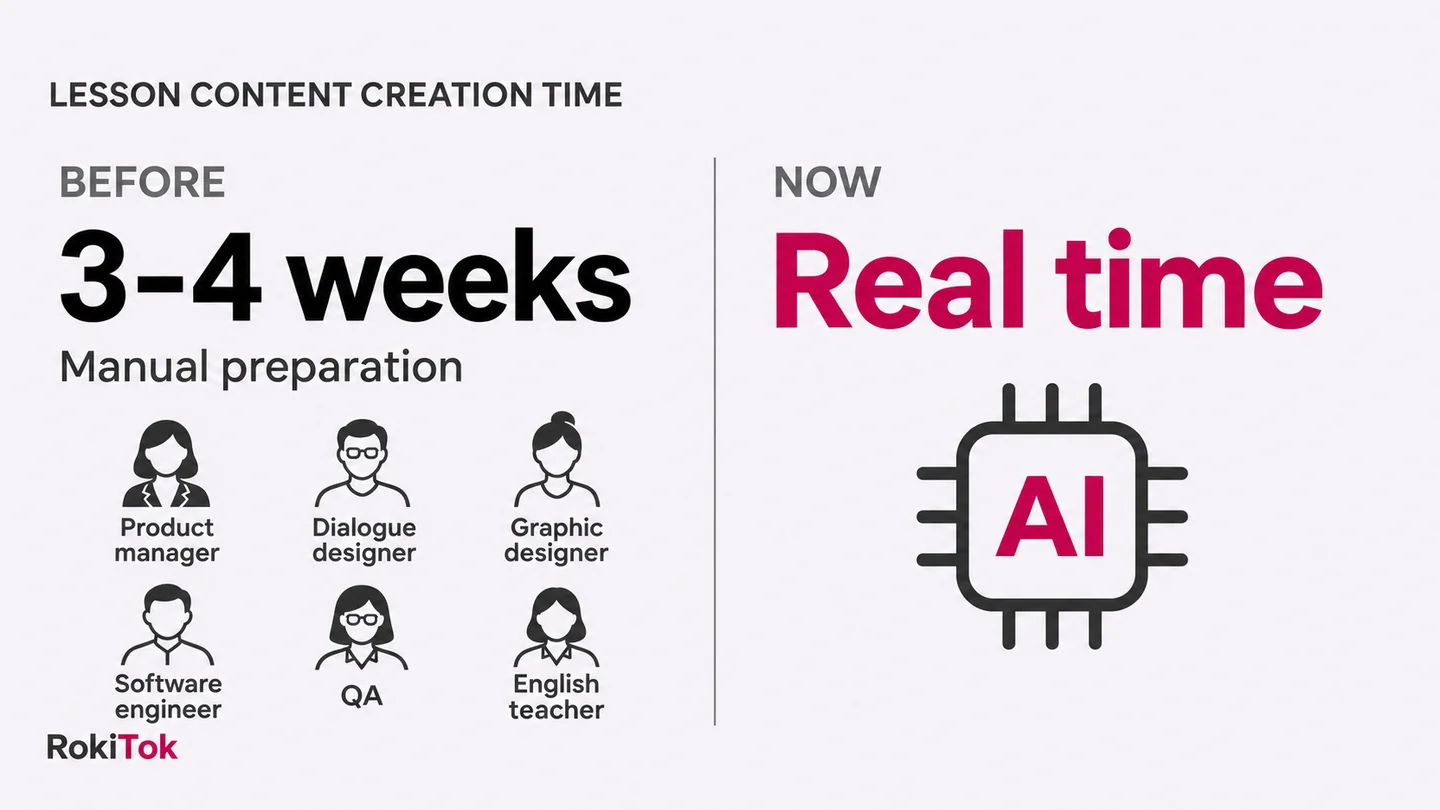
Second, we wanted to apply the same thinking to how we built the product. Rather than assembling a conventional team of developers, designers, AI engineers, and testers, we would rebuild the service using AI agents - with Product Managers setting the direction, reviewing the results, and deciding what was ready to ship.
A few years earlier, both ideas would have been difficult to put into practice. By 2026, we could make it a reality.
September 2026: built by AI
We brought RokiTok back in September 2026. AI agents carried out the implementation from end to end: code, interface design, lesson logic, and testing.
The decisions that mattered were still ours: what the product should do, what a good lesson feels like, and what was ready to ship.
What changed was the distance between deciding something and watching it work in Production. That used to take weeks, but not anymore.
We could try an idea, review the result, and refine it much faster. For a product we had struggled to move forward with the resources available, that opened up new possibilities.
AI had become both the foundation of the learning experience and the core resource for building it.
What RokiTok does today
RokiTok pays attention to the learner. It remembers what you did last time, assesses your level through conversation, and uses that context to shape what comes next.
- It carries on from last time, building on previous lessons instead of starting over.
- It corrects you while you talk, displaying words and pictures on the board as you go.
- It talks about what you care about, whether that is a job interview, ordering dinner, or your own work.
- If you get stuck, it helps in your own language, returning to English when you are ready.
Nobody wrote these lessons in advance. They are generated as you go, tailored to each learner.
The aim is to make practice relevant enough that learners want to keep coming back and to give them room to speak, make mistakes, and improve.
This is only the start (and not only for language learning)
RokiTok shows how much can change when a product idea meets the right technology. An experience we could not afford to expand in 2022 became something we could rebuild in 2026, with a much leaner team and AI doing both the lesson generation and the engineering.
At Atify, we have already been applying this approach beyond language learning, including in e-commerce and HR technology. RokiTok is one example of a wider opportunity: making ideas practical that previously required more time, money, and people than a business could commit.
There is still plenty to improve and explore. But we can now spend more time developing the experience we imagined, because creating each new piece no longer carries the same cost.
We are excited to continue discovering how far this can go!