 Atify
Why 2026 is the year AI phone calls stopped sounding like robots, and what that means for marketing teams.
If you have called an airline, a bank or a mobile carrier in the last ten years, you have almost certainly talked to a machine. Voice automation in customer support is old news: menus, call routing, “say your account number”, and more recently AI that listens in and helps the human agent. It works because the caller wants something and is willing to cooperate.
Marketing is a different story. On an outbound call nobody is waiting for you. The person on the other end is busy, sceptical and ready to hang up at the first sign of a robot. That is why AI voice in marketing has lagged behind support for years. This year, that gap started to close.
Customer Support
Customer service has been the proving ground for voice AI. The use cases are narrow and the caller is motivated: check a balance, rebook a flight, reset a password. Even a clunky system gets the job done when the customer wants it to.
The numbers show how far support has gone. In a RingCentral and G2 study published in October 2026, 57% of business leaders said they already run voice AI agents and another 10% are piloting them. The listed use cases are mostly support work: service, scheduling, call routing, reminders and follow-ups. Gartner expected 73% of service organisations to have agent-assist tools in place by the end of 2025.
It is not perfect. Gartner also found that 87% of customers want a way to reach a human when a company uses AI for service. Still, in support, voice AI is part of the everyday toolkit.
Why marketing calls were so much harder
A marketing call is a real conversation, not a form filled in by voice. The prospect interrupts, pushes back, changes the subject and decides in seconds whether to keep listening. Until recently, most voice AI was built as a relay of three models: speech-to-text, then a language model, then text-to-speech. OpenAI’s own first ChatGPT Voice worked this way. That design breaks down in exactly the places a sales conversation needs it most:
- Barge-in. People interrupt. A relay system often keeps talking over the prospect, or stops so abruptly that the conversation loses its thread.
- Knowing when a phrase is over. Humans hesitate, trail off and pause mid-sentence. A system that waits for silence either jumps in too early or leaves an awkward gap.
- Speed. In human conversation the typical gap between turns is about 200 milliseconds. Three models in a row add up to a second or more, and people notice.
- Small signals. “Mm-hm”, “right”, a laugh, a sigh. A transcript drops all of them, so the AI misses whether the person is interested, annoyed or confused.
- Recognition under real conditions. Names, company names, phone numbers, accents, background noise and mobile lines all cause errors that a support bot can recover from but a cold call cannot.
- Objections. “Send me an email”, “we already have a vendor”, “how did you get my number?” Scripted bots handled these poorly, and one bad answer ends the call.
- Trust and law. People are wary of robocalls, and regulators treat AI voices strictly (more on that below).
In support, a slightly robotic call is an annoyance. In marketing, it is a lost lead and sometimes a damaged brand.
Marketing is catching up, carefully
Marketing teams have not ignored AI. Text came first: AI-written emails, ads and chat on websites. Voice in marketing has moved more slowly, and the surveys show it.
Based on US and global surveys, mostly of mid-size and large companies (not Japan-specific). Each bar comes from a different survey, so compare them as rough scale only. Sources: RingCentral & G2 (Oct 2026), Salesforce State of Service, Auto Interview AI (2026).
The gap has a simple cause. When a support bot stumbles, the customer still needs an answer and tries again. When a sales bot stumbles, the prospect hangs up and remembers the brand. Businesses were right to be careful: an awkward AI call costs more than no call at all.
Businesses clearly want AI in marketing. In McKinsey’s 2026 survey, marketing and sales is the area where companies most often say AI has increased their revenue. The demand was there. What held voice back was that AI phone conversations did not sound good enough.
What changed in 2026: full-duplex voice
The breakthrough this year is full-duplex voice models. Like two people on a phone line, they listen and speak at the same time. One model hears the audio directly and decides many times per second whether to keep talking, pause, let the other person in, or look something up.
How AI phone calls work, before and after full-duplex models
Several major releases landed within months of each other:
- April: ByteDance introduced Seeduplex, a native full-duplex speech model.
- July: OpenAI launched GPT-Live, its full-duplex voice model, now behind ChatGPT Voice. It hands hard questions to a stronger reasoning model while it keeps the conversation going.
- July–August: NVIDIA released NemotronLabs VoiceChat with open weights, the first open full-duplex model that can call tools mid-conversation.
- November: Boson AI previewed Higgs Realtime Duplex, which adds interruption handling, tool use and handing tasks to larger models.
For a marketing call, this fixes most of the list above. The AI can be interrupted naturally, hears hesitation and tone rather than a flat transcript, answers at human speed, and can check a CRM or a calendar without going silent. The conversation feels close to talking with a person. Behind it sits a model that has read the product sheet, remembers the whole call and never has a bad day.
What this opens up for businesses
When a call no longer sounds like a robot, the phone becomes a channel that small and mid-sized companies can use again, not only large call centres. The uses we see as most promising:
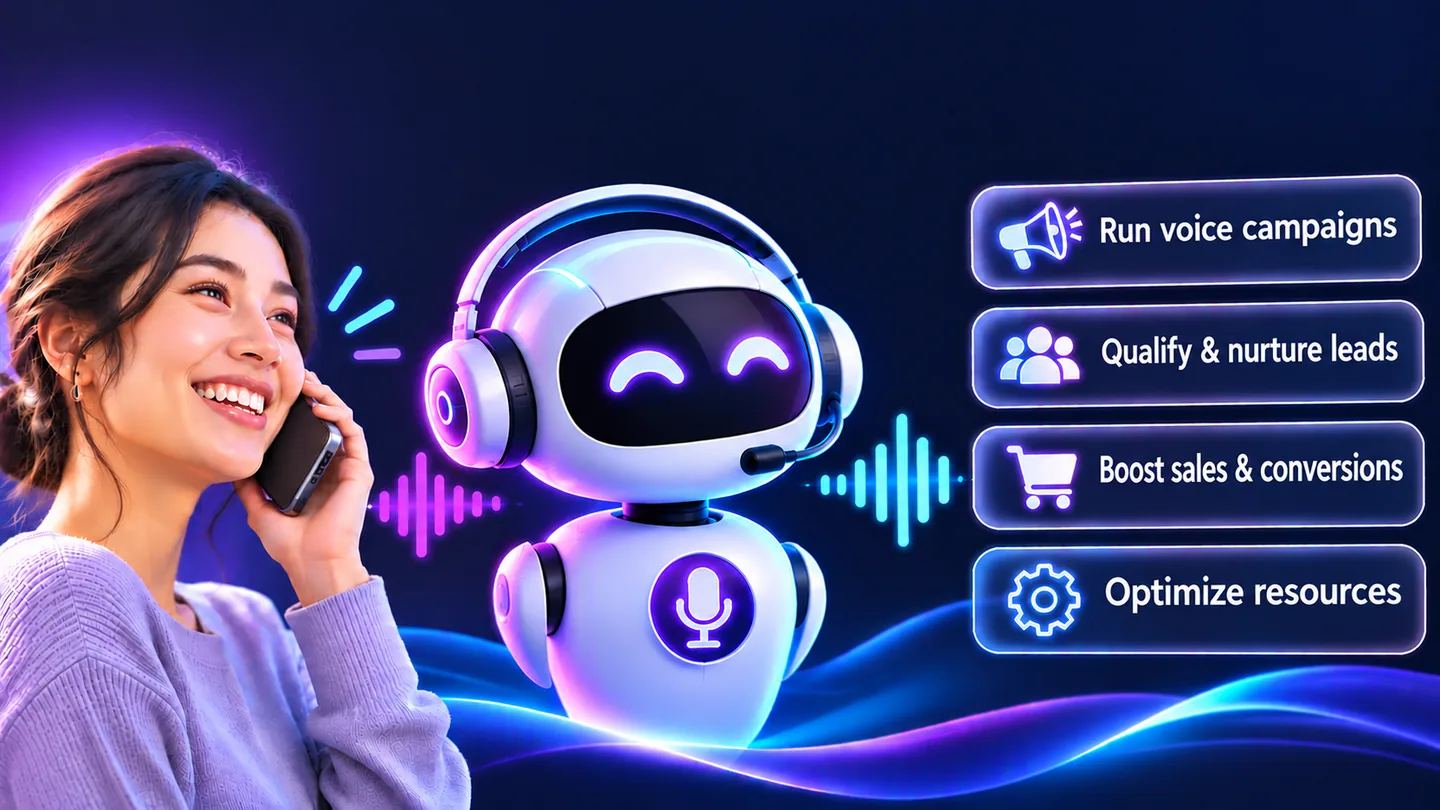
- The follow-up call after the email. Someone opened your email, registered for a webinar or filled in a form. A short, friendly call the same day often does more than a third reminder email.
- Waking up old leads. Most companies have hundreds of contacts nobody has called in a year. An AI agent can work through them politely and pass the warm ones to a person.
- Qualifying and booking. The AI asks the few questions that matter, answers common objections, and books a meeting straight into a salesperson’s calendar.
- Event and offer invitations. Seminars, demos, seasonal offers: short calls at scale, each one still a real two-way conversation.
- Multilingual campaigns. One campaign can run in English, Japanese and other languages without hiring a separate team for each market.
- Consistent quality. Every call follows the agreed message, is recorded and summarised, and the script can be improved from real results the next morning.
The point is not to replace salespeople. It is to let them spend their time on conversations that are already warm.
How we use it at Atify
We believe the best way to advise clients on a new technology is to run it on our own business first. That is why we built SaleScale Marketer, the outreach tool behind our own SaleScale marketing, and added AI phone calls to it this autumn.
Marketer has two services that work together:
- Email marketing sends campaigns from our own mailboxes to our contact base, with proper unsubscribe handling.
- Phone marketing places AI-driven calls to the same contacts, starting with the US, Japan, the Philippines and the UK, from local phone numbers.
Setting up a call campaign looks more like briefing a new team member than programming a robot. In plain language we define who the agent is calling for, what the offer is, what to ask, how to handle common objections, and when to hand over to a person. The schedule, calling hours and call prompts stay fully editable by our team, so we stay in control of what is said, when, and to whom.
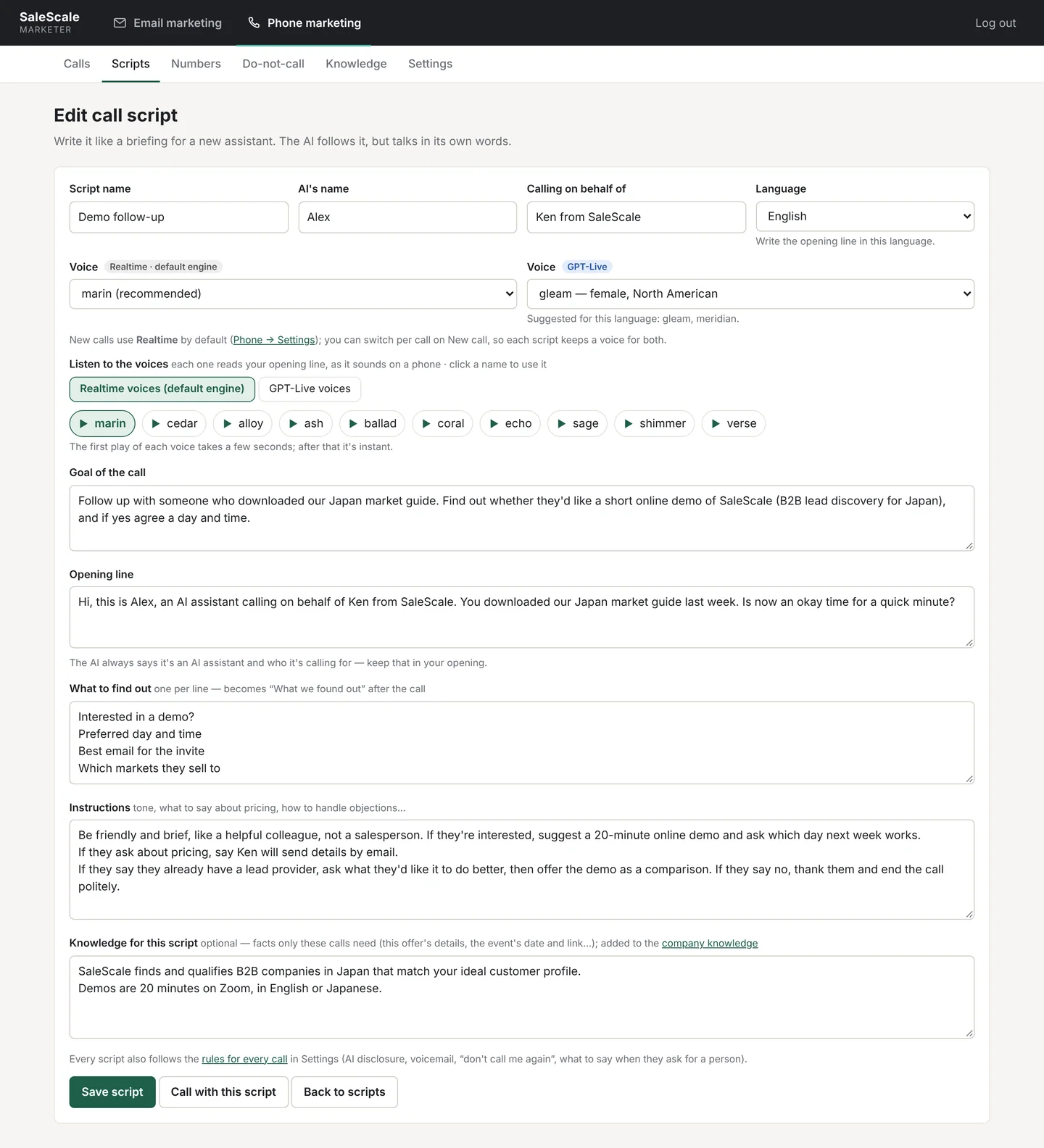
A call script in Marketer: the goal, the opening line, what to find out and how to handle objections, written in plain language.
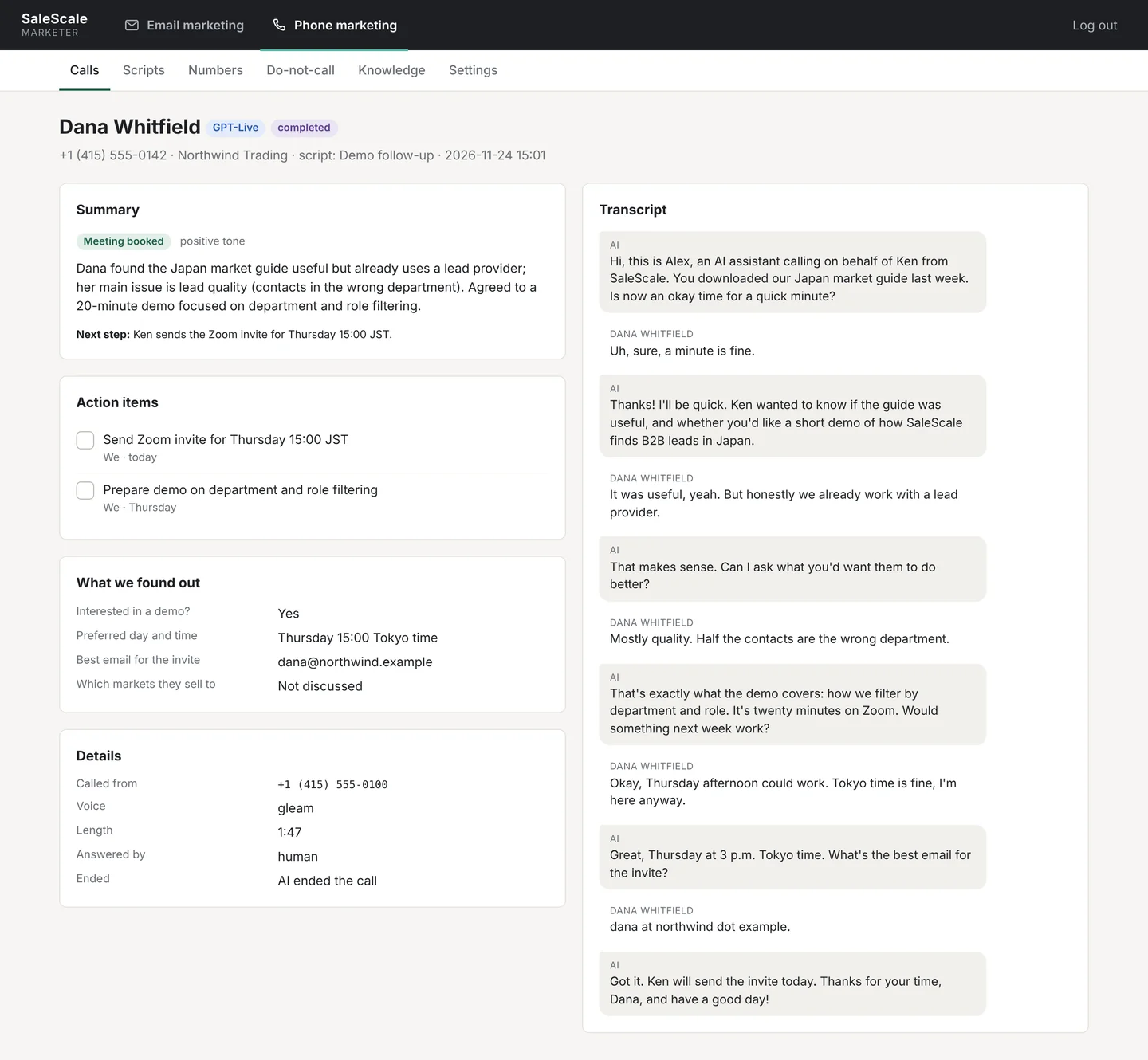
After the call: an AI summary, action items, the answers it collected and the full transcript. Demo data.
We are also building voice agents for clients, including a call-centre operator who needs calls that are friendly, natural, and start by confirming the agent is speaking with the right person. What we learn on our own campaigns goes straight into that client work, and vice versa.
Doing it responsibly
When an AI sounds human, it should always be clear that it is an AI, and the people it calls should be treated with respect.
Telemarketing and AI calling are regulated differently in every country, and the rules keep changing as AI voices become more common. Consent, disclosure, calling hours and opt-out requirements can all differ between markets. That is why every campaign must follow the laws, regulations and industry norms of each country it calls into, checked before launch and reviewed as they change.
Our own rules on every campaign:
- The agent says it is an AI assistant and who it is calling for.
- We call people who know us or have agreed to hear from us.
- A “no” is final: the contact is removed from the campaign at once.
- Calls go out only within local business hours.
- A person can always take over the conversation.
Every company using AI calls needs to follow the compliance rules and regulations that apply to it.
Let’s talk
Voice is the most human channel a business has, and for the first time AI can use it well. If you want to see what AI calls could do for your marketing, or for your call centre, get in touch with the Atify team. We would be happy to arrange a demo and show you what our solutions can do.